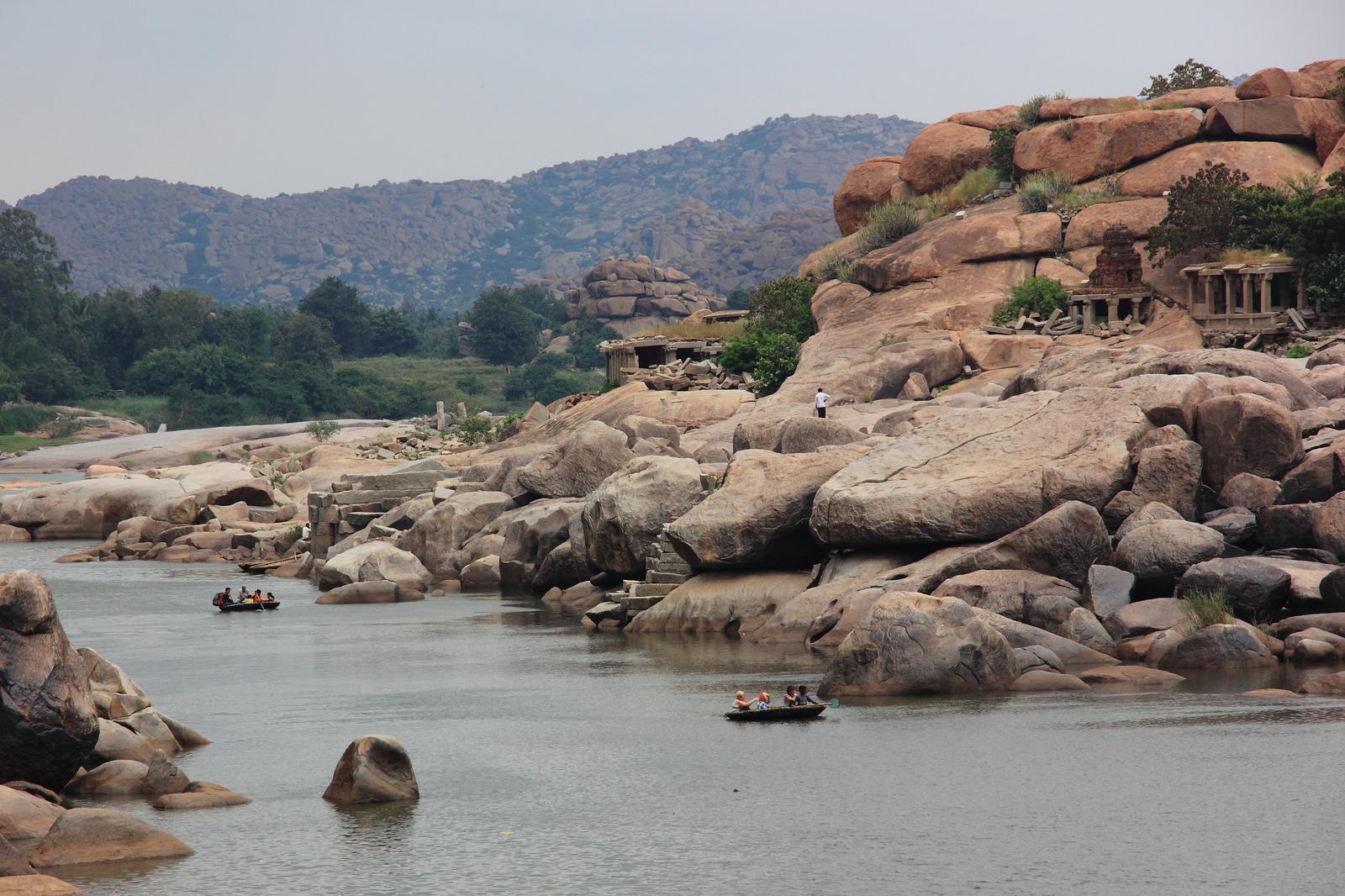

Surrounded by an otherworldly landscape of sun-scorched amber boulders and dramatic granite crests, Hampi rises like a spectacular mirage in the rural heart of Karnataka, India. Today, this UNESCO World Heritage Site is a serene wonderland spread across a staggering 4,100 hectares of rugged terrain. Yet, beneath its peaceful rustic charm lies a cinematic history of unimaginable wealth, artistic brilliance, and a catastrophic fall that froze a global metropolis in time.
Long before the legendary Vijayanagara Empire transformed it into a jewel of the medieval world, Hampi was deeply steeped in sacred myth as Pampa-kshetra or Kishkindha-kshetra. Hindu theology describes how a determined goddess Parvati embarked on an intense ascetic lifestyle on Hemakuta Hill to win the heart of Lord Shiva, earning him the title Pampapati. The sacred Tungabhadra River was named the Pampa River to honor her spiritual triumph. Centuries later, the Ramayana immortalized these lands; it was here, amidst the rugged caves of Kishkindha, that Lord Rama met Hanuman and forged the legendary monkey army to rescue Sita.
Moving from myth into recorded history, this sacred pilgrimage spot naturally caught the attention of ancient empires. Emperor Ashoka’s third-century BCE rock edicts found nearby hint that Hampi was once tethered to the Maurya Empire. As centuries rolled on, the Badami Chalukyas, Kalyana Chalukyas, and Hoysala Kings each left their artistic signatures on the region, constructing early shrines and offering lavish land grants to honor local deities.
However, the modern destiny of Hampi was forged out of absolute chaos. The early fourteenth century witnessed devastating northern invasions as the armies of the Delhi Sultanate plundered the wealthy capitals of South India. Following the collapse of the Hoysalas and the nearby Kampili kingdom, two visionary brothers, Harihara I and Bukka I, rose to the occasion. Guided by the spiritual counsel of Vidyaranya, the Jagadguru of the Sringeri Sharada Peetham, the brothers established a new kingdom in 1336 CE. They chose Hampi as their capital, naming it Vijayanagara: the City of Victory.
For more than two centuries, the Vijayanagara Empire stood as a bulwark of Hindu culture, prosperity, and military might in South India. By the year 1500, Hampi-Vijayanagara had swelled into a sprawling, cosmopolitan megacity, estimated to be the second-largest city in the medieval world after Beijing, and extraordinarily the wealthiest metropolis in India. The sheer opulence of its bustling markets and grand public infrastructure attracted affluent merchants from Persia, Arabia, and the Portuguese colony of Goa.
Yet, this golden age came to a sudden, violent end. The surrounding Muslim sultanates formed a powerful coalition to check the empire's dominance. In 1565, at the fateful Battle of Talikota, the Vijayanagara forces suffered a crushing defeat, and their venerable king, Aliya Rama Raya, was captured and beheaded. The triumphant armies descended upon the defenseless capital. For six agonizing months, the metropolitan wonder of Vijayanagara was methodically pillaged, looted, and torched. The city was abandoned to the elements until a British East India Company engineer named Colonel Colin Mackenzie systematically brought its forgotten architectural treasures back to global light during the early 1800s.
To truly comprehend Hampi is to understand its brilliant dual layout, which seamlessly blends the spiritual with the political. Archaeologists broadly divide this massive historical site into two primary zones known as the Sacred Center and the Urban Core.
The Sacred Center hugs the southern banks of the life-giving Tungabhadra River. This zone was designed specifically to honor the gods and welcome waves of weary pilgrims. It is defined by colossal temple complexes, each functioning as a self-contained mini-city with its own religious shrines, administrative quarters, massive community kitchens, and wide, colonnaded bazaar streets designed to accommodate grand chariot festivals.
Further inland to the south lies the Urban Core, also referred to as the Royal Center. This heavily fortified zone served as the nerve center of imperial governance and elite life, acting as the private domain of kings, queens, commanders, and court officials. Here, the architectural style undergoes a fascinating evolution; while traditional South Indian Hindu artistry remains foundational, the builders strategically incorporated Indo-Islamic architectural elements, resulting in elegant arches, vaulted domes, and delicate plaster decorations.
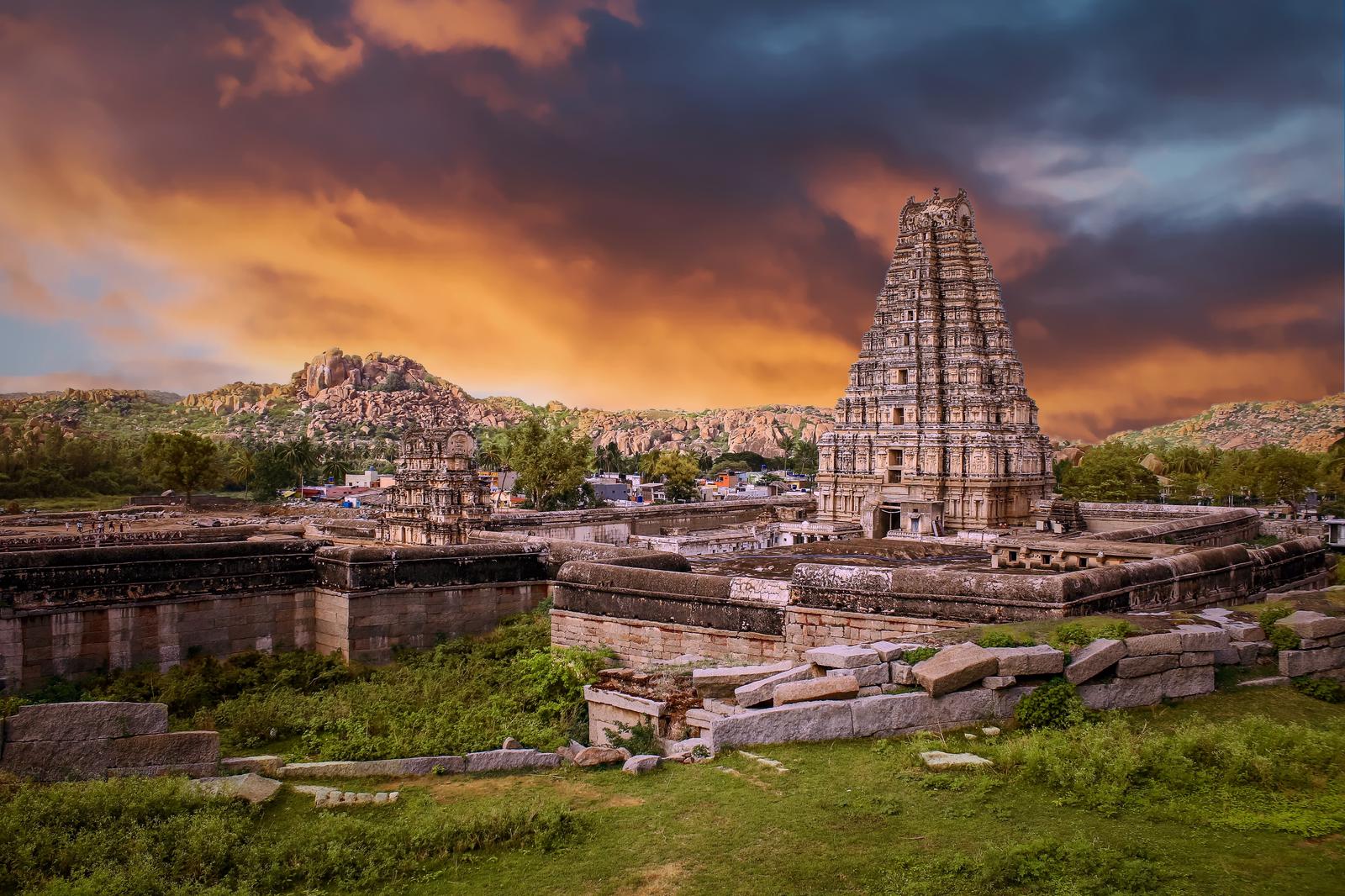
Standing proudly as the oldest and sole continuously active place of worship since the city's destruction, the Virupaksha Temple is the spiritual heart of Hampi. Dedicated to Lord Shiva, its origins date back to the seventh century, though it was grandly expanded during the Vijayanagara golden era. The temple is dominated by a majestic, 50-meter-high entry gateway that pierces the skyline with its multi-tiered pyramidal tower. The ceilings of the open mandapa, constructed by the great king Krishnadevaraya, feature stunning, vibrant paintings depicting the celestial marriage of Shiva and Parvati, scenes from the Ramayana, and a historic procession honoring the sage Vidyaranya. Outside the main entrance stretches the ruined, 750-meter-long stone Hampi Bazaar.
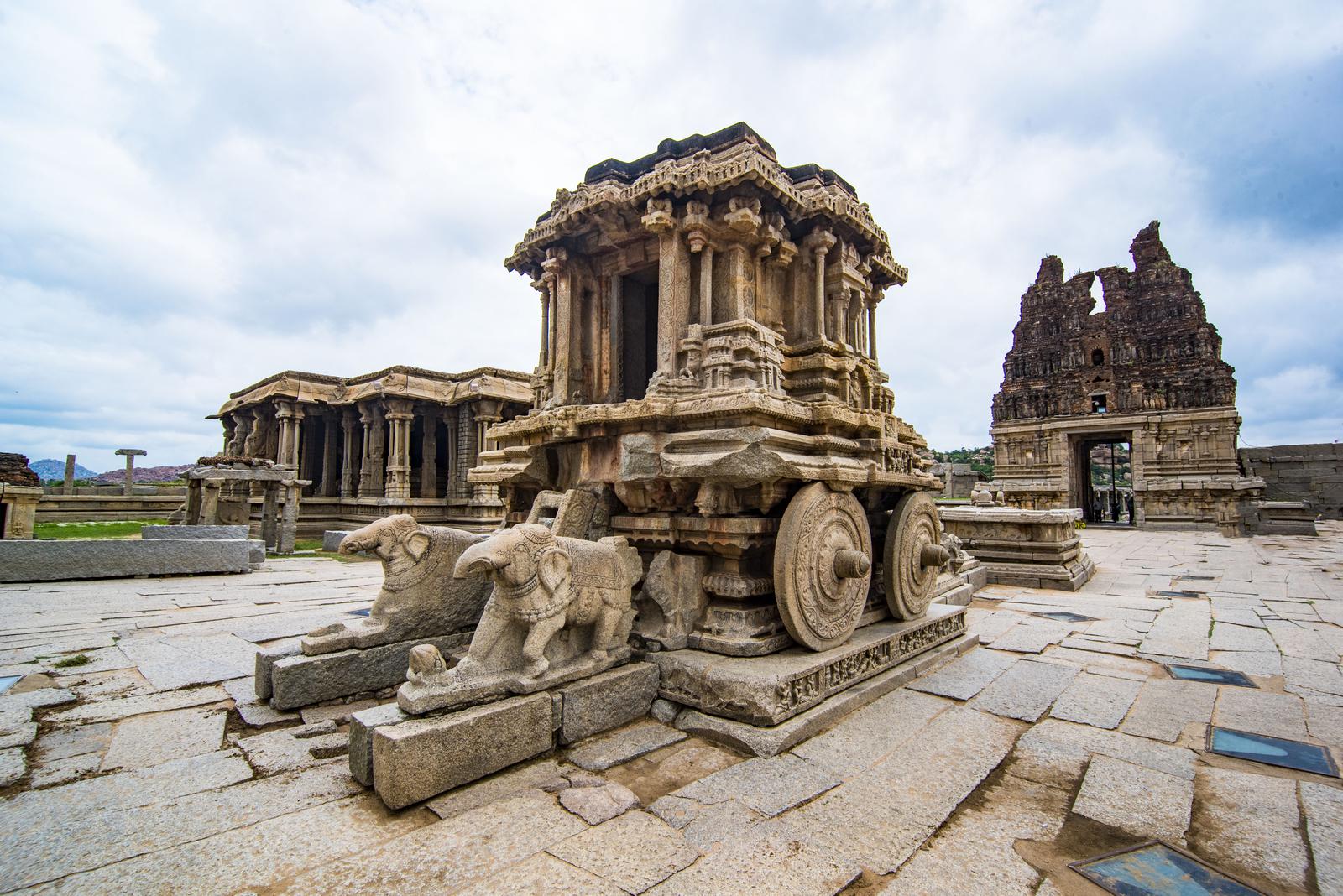
Located along a scenic bend of the Tungabhadra River, the Vitthala Temple complex represents the artistic zenith of Vijayanagara craftsmanship. Dedicated to Vitthala, a celebratory form of Lord Krishna, the entire complex is a masterclass in stonework. At the center of the courtyard stands Hampi’s most iconic visual symbol: the Garuda Shrine, meticulously sculpted in the shape of a monumental stone chariot with beautifully detailed stone wheels. Directly facing this chariot is the legendary Mahamandapa, a grand community hall featuring 56 impossibly carved stone pillars. These columns are fashioned from single blocks of resonant granite, shaped and finished so precisely that they emit distinct musical notes when gently struck.
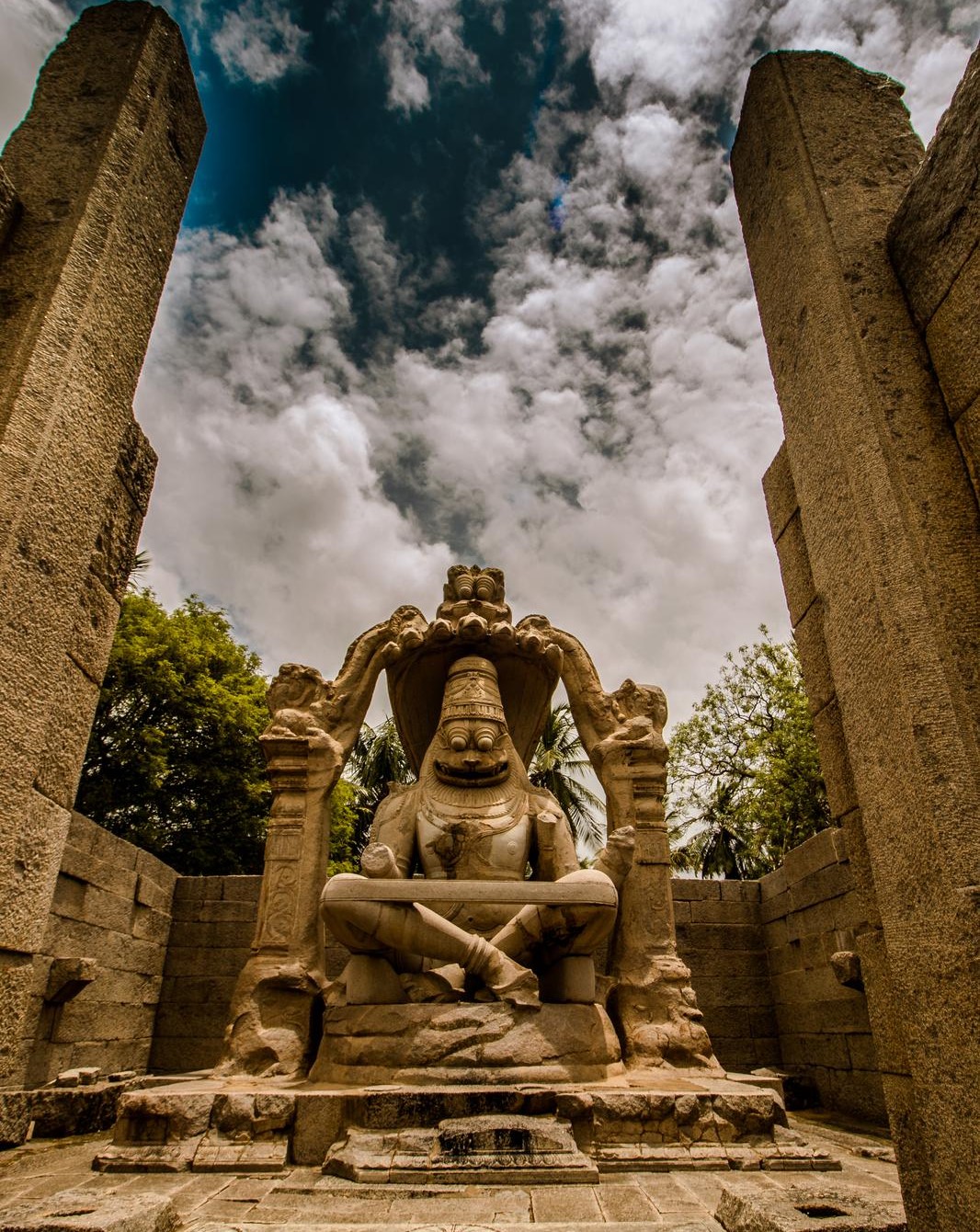
Built by King Krishnadevaraya in 1515 CE to celebrate a triumphant military campaign in Orissa, the Krishna Temple complex is another structural masterpiece. Just a short walk to the south of this complex lie two of Hampi’s most jaw-dropping monolithic sculptures, carved directly into the natural bedrock. The first is the Badavilinga, a colossal, three-meter-high Shiva Linga that stands permanently in a water-filled cubical stone chamber. Immediately adjacent is the Yoga-Narasimha monolith. Standing over six meters high, this fierce, man-lion incarnation of Vishnu is depicted seated in a cross-legged yogic posture. Though severely damaged and scarred by the fires of the 1565 invasion, the monument remains a powerful testament to ancient artistic ambition and technical skill.
Gently rising between the Virupaksha and Krishna temples, Hemakuta Hill is a peaceful expanse of smooth granite slopes scattered with more than thirty compact shrines. This hill offers an architectural timeline of Hampi, preserving unique, early triple-shrine temples that predate the grand Vijayanagara era. The hill is also home to two famous monolithic sculptures of the elephant-headed deity, Ganesha. The Kadalekalu Ganesha features a 4.5-meter-high statue carved out of a massive boulder, named after his belly which resembles a local gram bean. Nearby sits the Sasivekalu Ganesha, a 2.4-meter-high monolith named for his mustard seed-shaped belly. A closer look at the reverse side of this sculpture reveals a delicate carving of his mother, Parvati, wrapping her arms protectively around her son's torso.
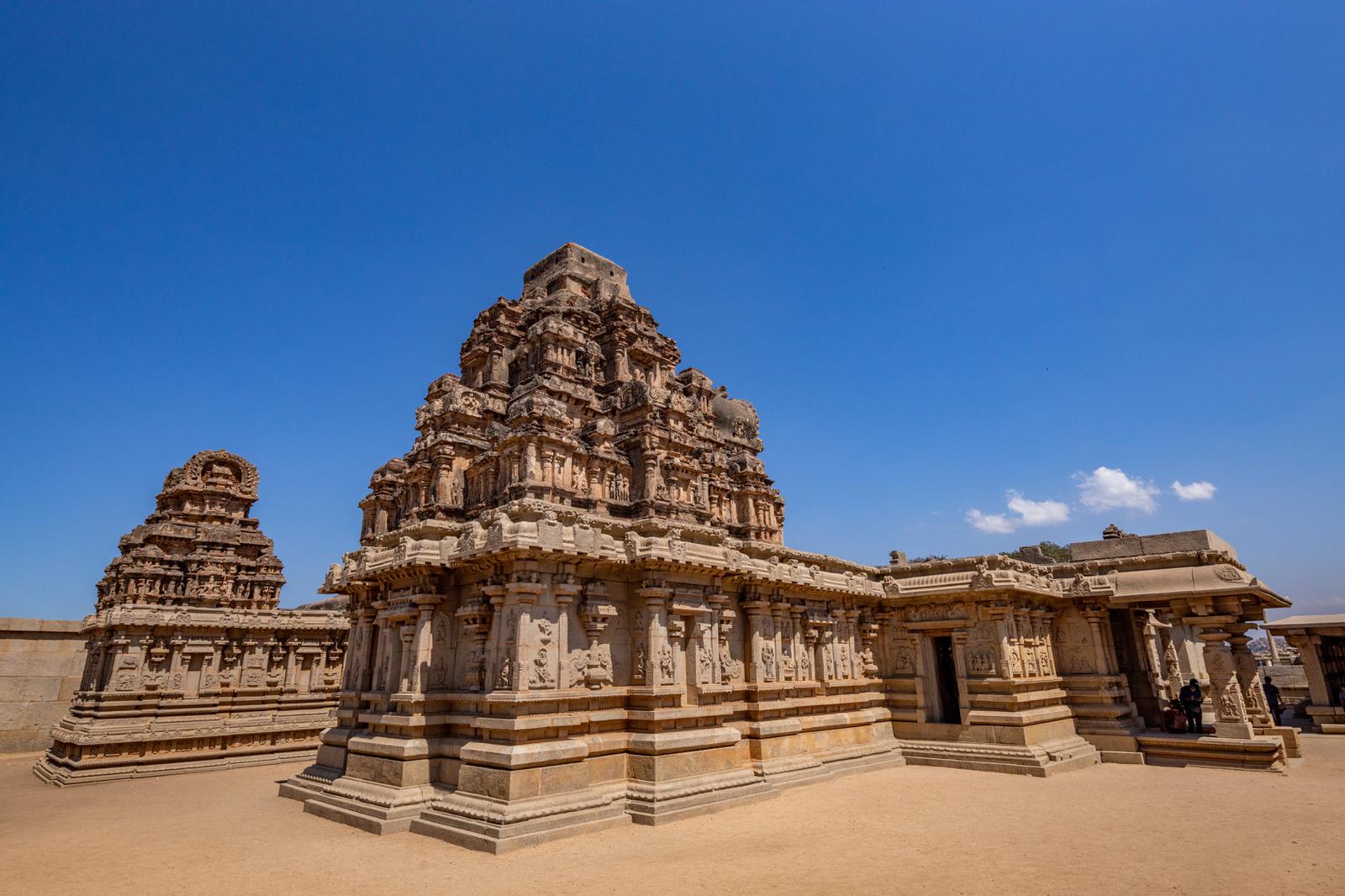
Positioned squarely within the royal center, the Hazara Rama Temple (Temple of a Thousand Ramas) functioned as the private, ceremonial place of worship for the royal family. Attributed to King Devaraya I in the early fifteenth century, this temple is essentially a beautifully illustrated storybook made entirely of stone. The exterior granite walls are carved with parallel, horizontal bands of relief artwork that document annual celebrations, marching elephants, and dancing women. The inner courtyard walls are covered with rows of reliefs that methodically narrate the entire storyline of the Ramayana epic, while the central hall is supported by four dark, polished blackstone pillars carved in the ornate Hoysala style.
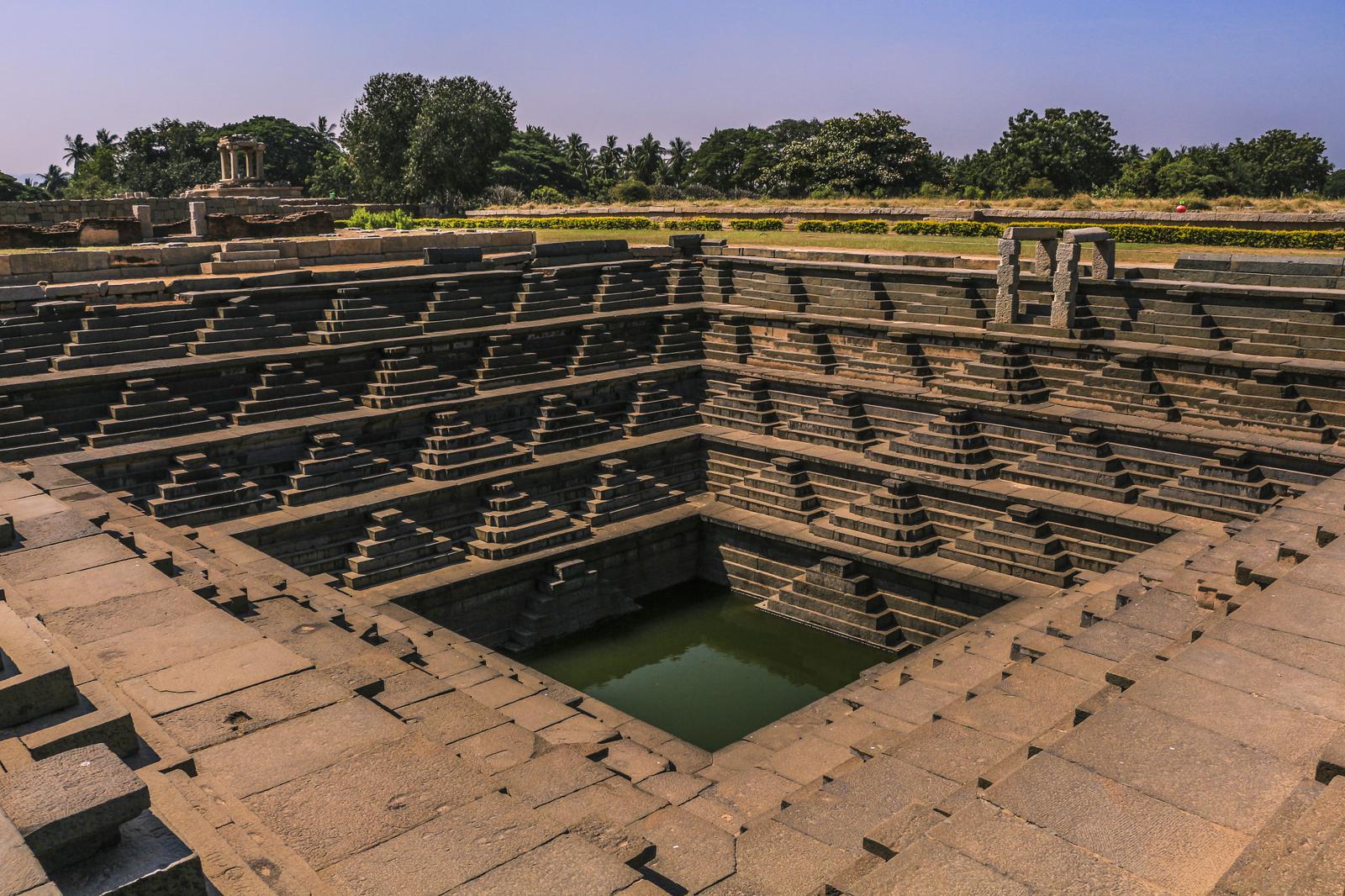
The Royal Enclosure acts as the civic heart of the urban core, featuring a massive public square complex that once housed the empire's administrative pavilions. The crowning jewel of this area is the Mahanavami Platform, a multi-tiered, square granite structure that stands as one of the highest points in the city. Often referred to in foreign chronicles as the House of Victory, this platform was the stage from which the king viewed the multi-day Dasara festival pageants and military parades. Just a short distance from the platform lies a stunning, symmetrical, stepped water tank constructed from dressed black schist blocks, which was meticulously excavated by archaeologists in the 1980s.
The sophisticated water management systems of the Vijayanagara Empire were foundational to sustaining its immense urban population. To distribute water throughout the sprawling metropolis, architects designed a sophisticated grid of stone aqueducts, terracotta pipelines, deep drainage channels, and overflow basins. Intensive excavations near the ceremonial Mahanavami Platform brought to light a majestic, square-stepped granite tank fed continuously by an elevated aqueduct line.
Hospitality and community dining were deeply woven into the socio-religious fabric of Hampi. South of the royal center, adjacent to a decorative octagonal fountain, lies one of Hampi's most innovative culinary designs: an open-air public Bhojana Shala, or house of food. Here, a long sequence of individual thalis (dining plates) and accompanying side-dish bowls are carved symmetrically directly into the flat bedrock on both sides of a long stone water channel. Flowing water ran parallel to the diners, providing an automated cleaning system for the outdoor royal mess.
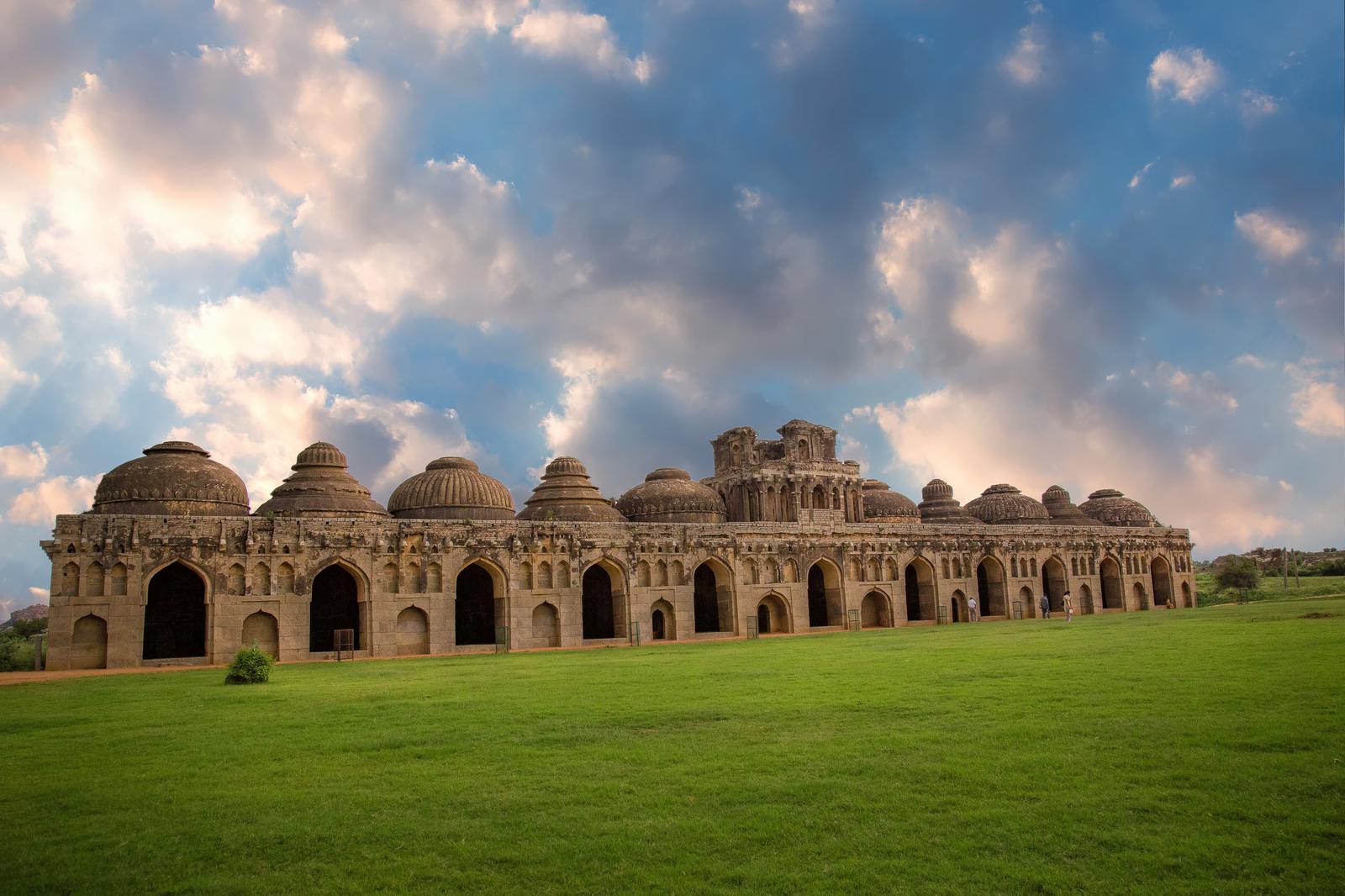
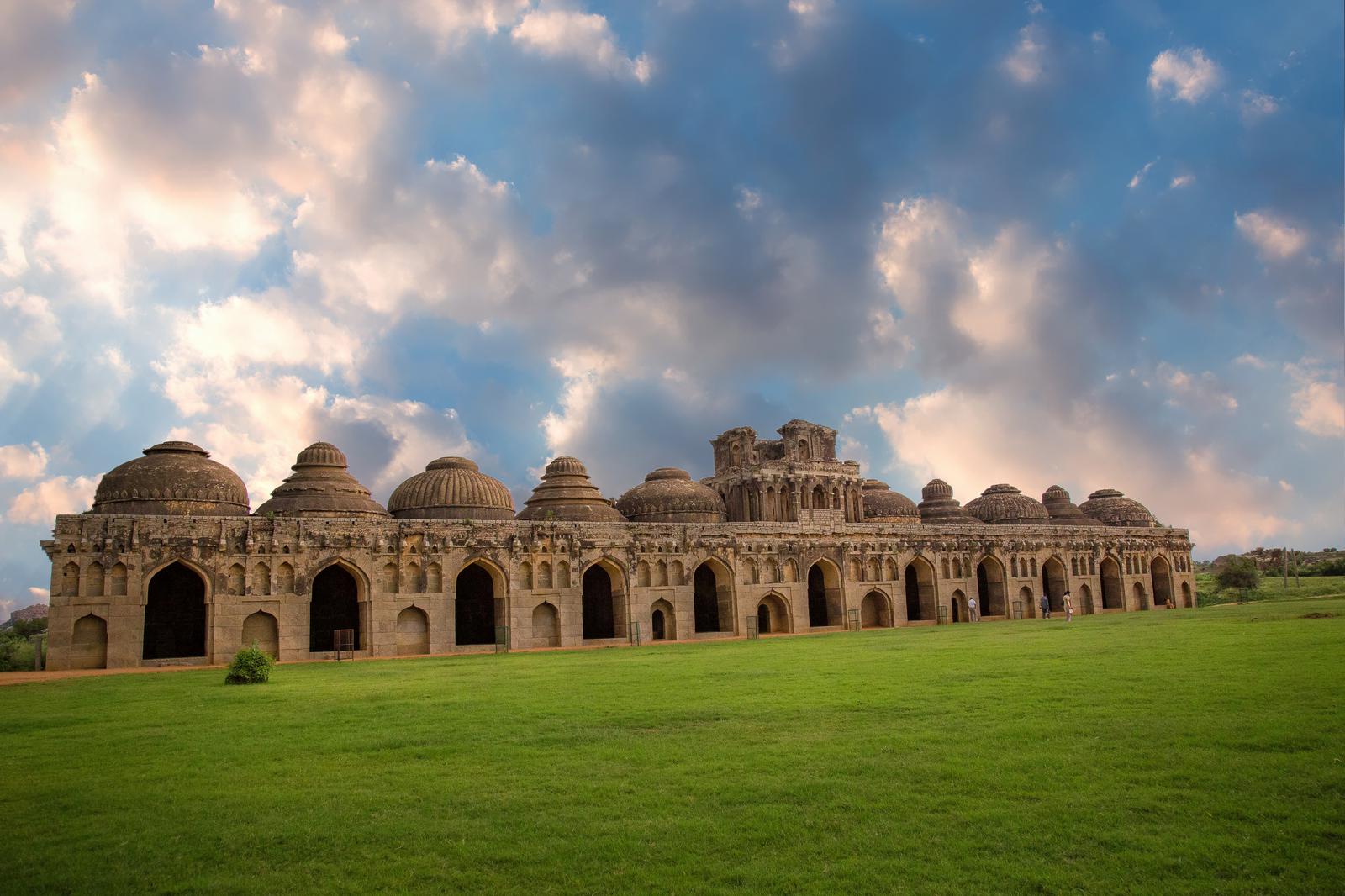
In the eastern quadrant of the royal center lies the Gajashala, or Elephant Stables, which served as the grand shelter for the empire’s elite military and ceremonial pachyderms. This monumental structure features eleven symmetrical, square chambers aligned precisely on a north-south axis. Each chamber opens via a lofty, monumental Islamic-style archway, while the roofline boasts alternating plain and fluted domes.
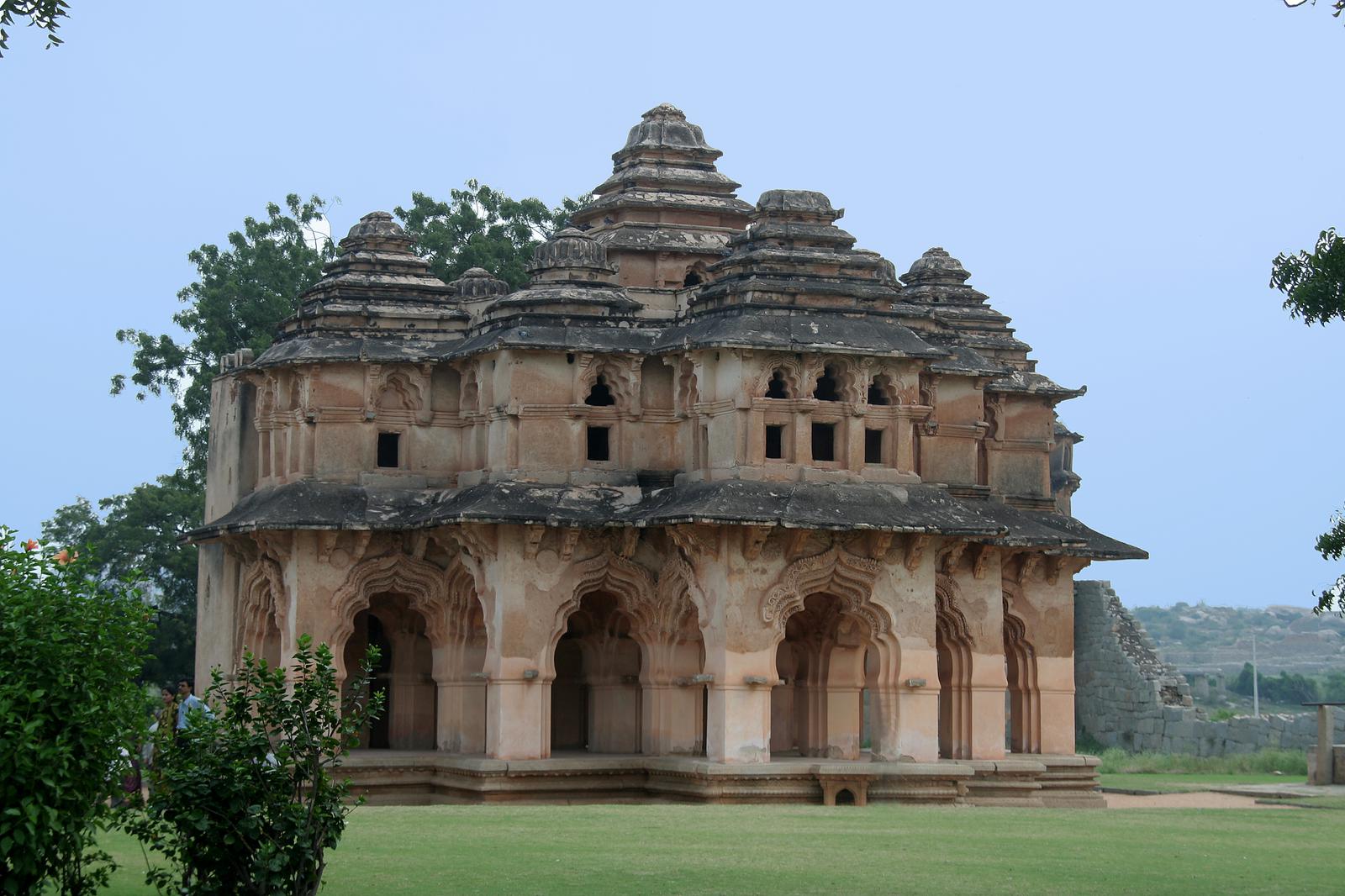
Situated right next to the stables is the fortified Zenana Enclosure, home to the celebrated Lotus Mahal. This two-story pleasure pavilion masterfully combines a symmetric, square Hindu mandala ground plan with the lobed arches, vaults, and plaster domes characteristic of Indo-Islamic secular architecture. The basement molding and the towering, pyramidal upper storeys draw directly from traditional Hindu temple design. Built without Islamic patronage, these structures showcase the deliberate, assimilative approach of the Hindu rulers, who freely adapted functional northern architectural elements to craft a unique metropolitan style.
Though Hampi was the capital of a major Hindu empire, it thrived as a multi-religious metropolis where Jain and Muslim communities maintained prominent neighborhoods and places of worship. The Jain architectural legacy is exceptionally rich, visible on Hemakuta Hill and within the urban core through structures like the Ganagitti Jain Temple, constructed in 1385 CE during the reign of King Harihara II. This temple features clean, unadorned granite exterior walls, an open pillared mandapa, and a square sanctum dedicated to the Tirthankara Kunthunatha.
Concurrently, a vibrant Muslim quarter developed in the northeastern valley of the urban core, a residential suburb where Islamic tombs and two mosques sit alongside contemporary Hindu and Jain structures. The most prominent monument here is the Ahmad Khan Complex, built in 1439 CE by a high-ranking Muslim officer serving in the army of King Devaraya II. Located near the historic Turuttu irrigation canal, the complex features an octagonal water well, a domed tomb with elegant plaster arches, and a pillared pavilion-style mosque designed without a traditional dome to blend seamlessly with Hampi's local architectural style.
Beyond Hampi’s immediate boulder fields and ruins lies a region rich in diverse landscapes, wildlife sanctuaries, and historical citadels, perfect for rewarding day trips.
Just across the river lies Anegondi, a tranquil, ancient village believed to be the mythical kingdom of Kishkindha from the Ramayana. Nearby rises Anjanadri Hill, revered as the birthplace of Lord Hanuman, where climbing the 570 stone steps to the summit temple rewards travelers with breathtaking sunset views over the boulder-strewn landscape.
For wildlife enthusiasts, the Daroji Sloth Bear Sanctuary offers a rare opportunity to witness native Indian sloth bears in their natural rocky habitat. From a safe watchtower, visitors can observe these reclusive creatures emerging in the late afternoon alongside leopards, jackals, and star tortoises. Further south, the massive Tungabhadra Dam creates a colossal reservoir that serves as a winter haven for migratory birds. Its base features beautifully landscaped Japanese-style gardens, musical fountains, and panoramic viewpoints.
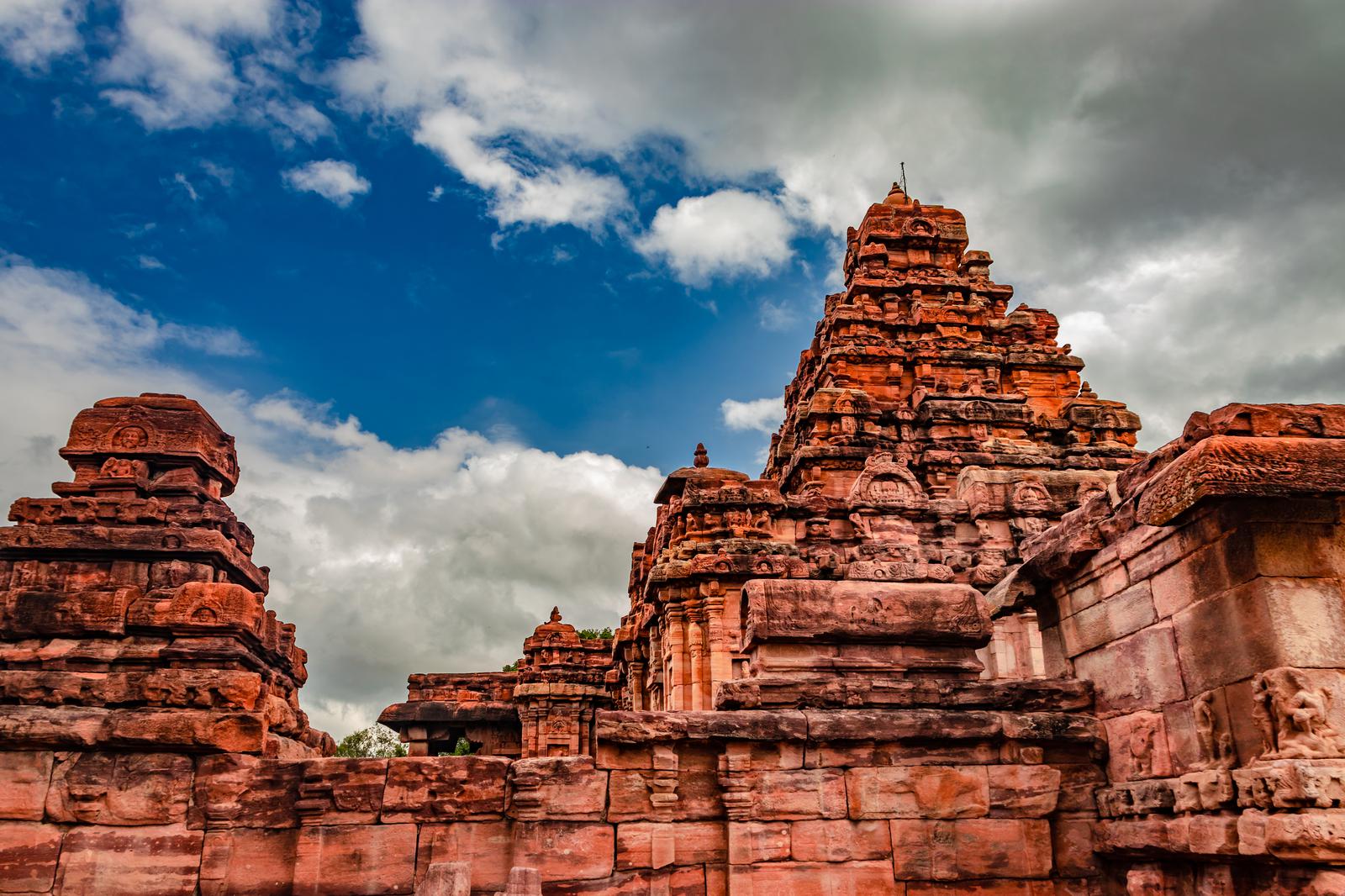
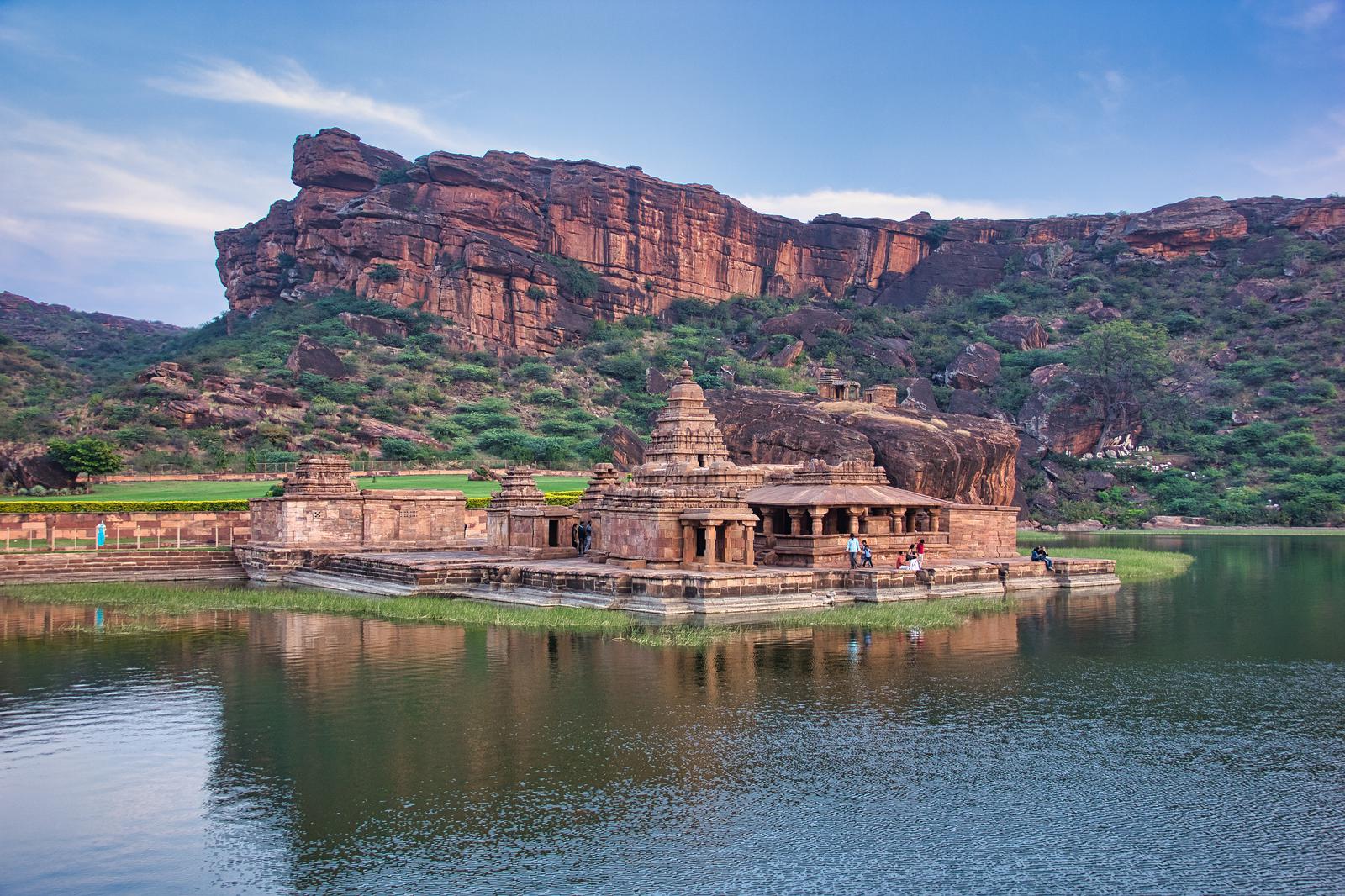
For a full-day historical excursion, the Badami, Aihole, and Pattadakal circuit northwest of Hampi showcases the cradle of early Chalukyan temple architecture from the 6th to 8th centuries. Badami features magnificent rock-cut cave temples in red sandstone cliffs, Pattadakal offers a UNESCO-listed blend of architectural styles, and Aihole serves as an open-air archaeological laboratory with over a hundred experimental early shrines.